
Throughout history, means of payment have been a tool of power. From barter, through gold and silver, to modern currencies, one constant has always existed: whoever controls money controls the flow of value, and therefore people, economies, and states.
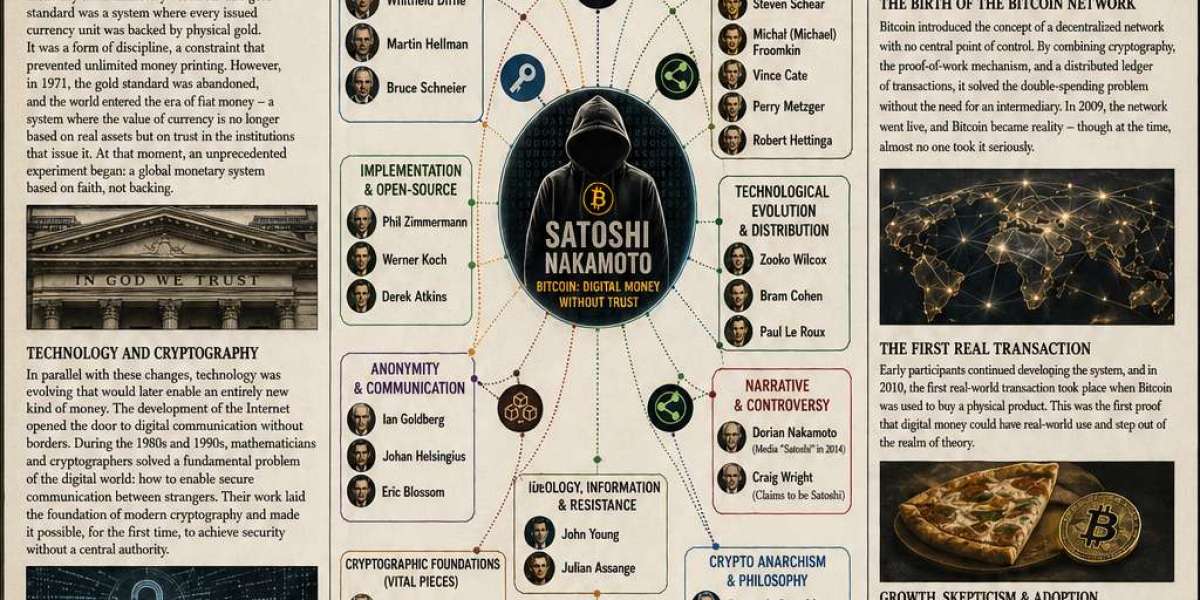
In the 20th century, one of the greatest transformations in the history of money took place. The gold standard was a system in which every issued unit of currency was backed by physical gold. It was a form of discipline, a limitation that prevented uncontrolled money printing. However, in 1971, the gold standard was abandoned, and the world entered the era of fiat money—a system in which the value of currency is no longer based on real assets, but on trust in the institutions that issue it. At that moment, an unprecedented experiment began: a global monetary system based on belief, not backing.
Parallel to these changes, technology was developing that would later enable an entirely new form of money. The rise of the internet opened the door to digital communication without borders. During the 1980s and 1990s, mathematicians and cryptographers emerged who solved a key problem of the digital world: how to enable secure communication between unknown parties. Their work laid the foundations of modern cryptography and, for the first time, made security possible without the need for a central authority.
From this technological environment, the cypherpunk movement was born—a group of programmers, mathematicians, and visionaries who believed that privacy is not a privilege, but a fundamental right. They began developing the idea of digital money that would exist outside the control of governments and banks. Their discussions, ideas, and experiments created the philosophical foundation for what would later become Bitcoin.
In the 1990s, the first attempts at digital money appeared. Electronic cash systems were developed with a focus on privacy, along with concepts of decentralized money. However, all of these systems had one critical flaw: they were either centralized or failed to solve the problem of double-spending without a central authority.
The year 2008 brought a global financial crisis that exposed the weaknesses of the existing system. Banks collapsed, governments intervened, and trust in financial institutions was severely shaken. At that very moment, a document titled “Bitcoin: A Peer-to-Peer Electronic Cash System” appeared, signed under the name Satoshi Nakamoto. This document was not just a technical solution, but a synthesis of decades of work by mathematicians, cryptographers, and cypherpunk ideologues.
Bitcoin introduced the concept of a decentralized network with no central point of control. By combining cryptography, a proof-of-work mechanism, and a distributed ledger of transactions, it solved the double-spending problem for the first time without the need for an intermediary. In 2009, the network went live and Bitcoin became a reality, although at the time almost no one took it seriously.
Early participants continued developing the system, and in 2010 the first real transaction took place when Bitcoin was used to purchase a physical product. For the first time, this proved that digital money could have real-world application, moving beyond theory.
In the years that followed, Bitcoin went through phases of growth, skepticism, regulation, and adoption. From an experiment, it became a global phenomenon. During the COVID-19 pandemic, massive monetary interventions occurred worldwide, further increasing interest in alternative forms of money. Bitcoin, as a limited and decentralized system, began to be seen as protection against inflation and monetary policy.
In recent years, institutional adoption has accelerated. Major financial entities have incorporated Bitcoin into their strategies, while states and regulators attempt to define its role within the global financial system. In this way, Bitcoin has traveled from an idea to an asset held in the portfolios of the world’s largest institutions.
Looking at the entire development, it becomes clear that Bitcoin is not the product of a single moment or a single person. It is the result of an evolution spanning decades—of mathematical discoveries, ideological movements, technological experiments, and economic crises. Satoshi Nakamoto, whether an individual or a collective, represents the point at which all these lines converge.
Today, Bitcoin is not just a currency. It is a concept, a technology, and a response to a system built over decades. From gold, to fiat money, to digital decentralization, the evolution of money reveals one clear truth: every new phase emerges as a response to the weaknesses of the previous one.
In that context, Satoshi Nakamoto is not just a name. It is a symbol of the transition from a world of trust in institutions to a world of trust in mathematics.
The Story of Satoshi Nakamoto!
The story of Satoshi Nakamoto does not begin in 2009. It begins much earlier, at the moment when people first realized that control over money means control over society. Throughout history, means of payment have been a tool of power. From barter, through gold and silver, to modern currencies, one constant has always existed: whoever controls money controls the flow of value, and therefore people, economies, and states.
In the 20th century, one of the greatest transformations in the history of money took place. The gold standard was a system in which every issued unit of currency was backed by physical gold. It was a form of discipline, a limitation that prevented uncontrolled money printing. However, in 1971, the gold standard was abandoned, and the world entered the era of fiat money—a system in which the value of currency is no longer based on real assets, but on trust in the institutions that issue it. At that moment, an unprecedented experiment began: a global monetary system based on belief, not backing.
Parallel to these changes, technology was developing that would later enable an entirely new form of money. The rise of the internet opened the door to digital communication without borders. During the 1980s and 1990s, mathematicians and cryptographers emerged who solved a key problem of the digital world: how to enable secure communication between unknown parties. Their work laid the foundations of modern cryptography and, for the first time, made security possible without the need for a central authority.
From this technological environment, the cypherpunk movement was born—a group of programmers, mathematicians, and visionaries who believed that privacy is not a privilege, but a fundamental right. They began developing the idea of digital money that would exist outside the control of governments and banks. Their discussions, ideas, and experiments created the philosophical foundation for what would later become Bitcoin.
In the 1990s, the first attempts at digital money appeared. Electronic cash systems were developed with a focus on privacy, along with concepts of decentralized money. However, all of these systems had one critical flaw: they were either centralized or failed to solve the problem of double-spending without a central authority.
The year 2008 brought a global financial crisis that exposed the weaknesses of the existing system. Banks collapsed, governments intervened, and trust in financial institutions was severely shaken. At that very moment, a document titled “Bitcoin: A Peer-to-Peer Electronic Cash System” appeared, signed under the name Satoshi Nakamoto. This document was not just a technical solution, but a synthesis of decades of work by mathematicians, cryptographers, and cypherpunk ideologues.
Bitcoin introduced the concept of a decentralized network with no central point of control. By combining cryptography, a proof-of-work mechanism, and a distributed ledger of transactions, it solved the double-spending problem for the first time without the need for an intermediary. In 2009, the network went live and Bitcoin became a reality, although at the time almost no one took it seriously.
Early participants continued developing the system, and in 2010 the first real transaction took place when Bitcoin was used to purchase a physical product. For the first time, this proved that digital money could have real-world application, moving beyond theory.
In the years that followed, Bitcoin went through phases of growth, skepticism, regulation, and adoption. From an experiment, it became a global phenomenon. During the COVID-19 pandemic, massive monetary interventions occurred worldwide, further increasing interest in alternative forms of money. Bitcoin, as a limited and decentralized system, began to be seen as protection against inflation and monetary policy.
In recent years, institutional adoption has accelerated. Major financial entities have incorporated Bitcoin into their strategies, while states and regulators attempt to define its role within the global financial system. In this way, Bitcoin has traveled from an idea to an asset held in the portfolios of the world’s largest institutions.
Looking at the entire development, it becomes clear that Bitcoin is not the product of a single moment or a single person. It is the result of an evolution spanning decades—of mathematical discoveries, ideological movements, technological experiments, and economic crises. Satoshi Nakamoto, whether an individual or a collective, represents the point at which all these lines converge.
Today, Bitcoin is not just a currency. It is a concept, a technology, and a response to a system built over decades. From gold, to fiat money, to digital decentralization, the evolution of money reveals one clear truth: every new phase emerges as a response to the weaknesses of the previous one.
In that context, Satoshi Nakamoto is not just a name. It is a symbol of the transition from a world of trust in institutions to a world of trust in mathematics.